
Introduction
Choosing the right form of sodium silicate is an important consideration for businesses across the United States. Liquid and solid sodium silicate each offer distinct handling, storage, transportation, and application advantages. Understanding these differences can help companies select the most practical option for their operations while supporting efficiency, cost management, and reliable supply.
Understanding Liquid Sodium Silicate
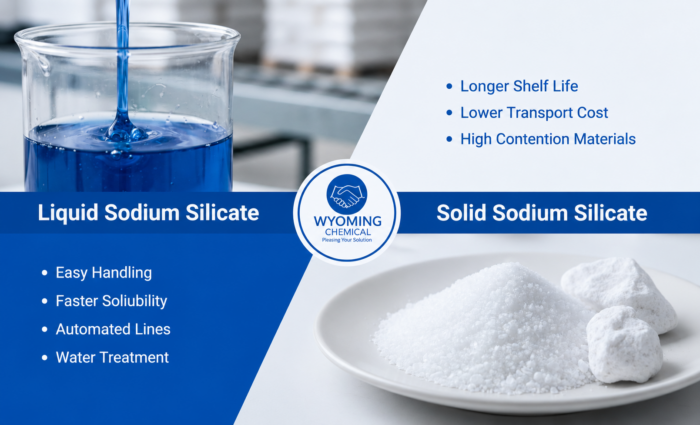
Liquid sodium silicate is a water-based solution valued for its ease of handling, convenient dosing, and compatibility with processes that require ready-to-use material. It is particularly suitable for operations with liquid handling and automated dispensing systems.
Key Benefits of Liquid Sodium Silicate:
- Simple handling and accurate dosing
- Rapid solubility and easy integration into processes
- Ideal for automated manufacturing environments
- Consistent formulation and performance
Common U.S. Industrial Applications:
Liquid sodium silicate is commonly supplied to industries such as:
- Detergent and cleaning products
- Water treatment
- Pulp and paper
- Adhesives and sealants
- Industrial processing
Understanding Solid Sodium Silicate
Solid sodium silicate is available in powder, lump, or granular form and is preferred in industries that require extended shelf life, concentrated material, and controlled dissolution rates.
Key Benefits of Solid Sodium Silicate:
- Convenient long-term storage
- Reduced transportation and storage costs
- Higher concentration levels
- Flexible dissolution based on process requirements
- Suitable for varied industrial requirements
Common U.S. Industrial Applications:
- Metal foundries
- Construction materials
- Cement and concrete products
- Refractory applications
- Insulation materials
Liquid vs. Solid Sodium Silicate: Which Should You Choose?
The right form depends on several factors, including how the material will be used, available storage facilities, transportation requirements, and the customer’s processing system.
Liquid sodium silicate may be preferable when ease of dosing, rapid integration, and automated handling are priorities.
Solid sodium silicate may be more suitable when concentrated material, storage flexibility, and transportation efficiency are important considerations.
There is no single solution for every application. The appropriate grade and form should be selected based on specific operational and supply requirements.
How Wyoming Chemical Distribution Supports Your Business
As a trusted U.S.-based chemical supplier, Wyoming Chemical Distribution connects customers with reliable sodium silicate products sourced through qualified supply partners. We work with businesses to help identify suitable product options based on their application and operational requirements.
Our distribution support considers:
- Application and product requirements
- Required grade and form
- Storage and handling capabilities
- Transportation and delivery needs
- Supply continuity and availability
- Cost and logistics considerations
By combining dependable sourcing with responsive distribution support, we help customers maintain a reliable supply of sodium silicate for their operations.
Conclusion
Both liquid and solid sodium silicate play essential roles across a wide range of industries. The best choice depends on your manufacturing process, operational goals, and supply chain needs. With dependable sourcing and expert support from Wyoming Chemical Distribution, businesses can confidently choose the right solution for long-term productivity and growth.